

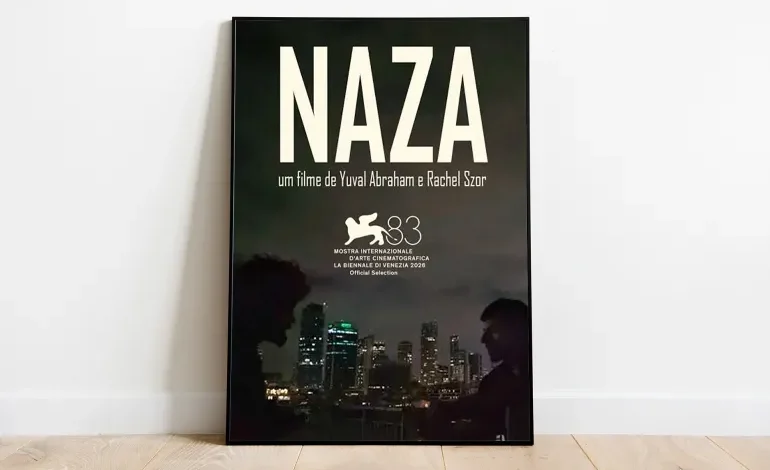
The documentary NAZA, directed by Israeli filmmakers Yuval Abraham and Rachel Szor, won the Special Jury Prize at the 83rd Venice International Film Festival in 2026. The film competed in the official selection and was the only documentary nominated for the Golden Lion. Its premiere also drew a strong response, with audiences applauding for nearly 24 minutes.
Testimonies from Within
NAZA is based on accounts from 24 Israeli soldiers and officers, including former military intelligence personnel. Some say they were involved in operating systems used to identify targets and prepare strikes in the Gaza Strip.
The interviews were conducted in secret, and the witnesses’ faces and voices were altered to protect their identities. The documentary examines several aspects of the targeting process, including:
- The deployment of large-scale surveillance systems.
- The analysis of data obtained from mobile phones.
- The use of artificial intelligence tools to identify targets.
- Prior knowledge that civilians were present in some buildings.
- Estimates of the number of people who could be killed in a given strike.
The film says its title refers to a term used in some military circles to estimate the potential number of civilian deaths during an operation. In this context, the title represents the reduction of human lives to figures within a military decision-making process.
Investigative Journalism Meets Cinema
The documentary emerged from an investigation lasting nearly three years and draws on reporting by +972 Magazine, Local Call, and the British newspaper The Guardian.
The directors seek not only to document the consequences of bombardment but also to trace the decisions that precede each strike. The film asks how targets are selected, what information is considered, who approves the operation, and how much human oversight remains in the process.
Through this approach, NAZA explores the connection between military technologies, databases, and decisions that can result in civilian deaths. It portrays war as an administrative and technological system in which human lives risk being reduced to statistical data.
Allegations, Responses
Based on the testimonies it presents, NAZA raises questions about compliance with international humanitarian law and whether some operations could constitute war crimes or crimes against humanity.
The film’s allegations should nevertheless be distinguished from a judicial determination. While the documentary offers testimonies and contextual information, the legal classification of the events requires independent investigations and decisions by competent courts.
The Israeli military rejected the allegations, saying that it targets Hamas and that its strikes undergo human review. It also accused Hamas of operating in civilian areas and using civilians as human shields.
Filmmakers
Yuval Abraham is an Israeli journalist and filmmaker known for his investigations into the occupation and Israeli military policies. Rachel Szor, a filmmaker and cinematographer, co-directed the documentary with him.

The film was produced with the support of The Guardian. British filmmaker Jonathan Glazer, who won an Academy Award for The Zone of Interest, is among the executive producers, while James Wilson serves as producer.
Following “No Other Land”
NAZA builds on the work Abraham and Szor began with Palestinian filmmakers Basel Adra and Hamdan Ballal in No Other Land, which won the Academy Award for Best Documentary Feature in 2025.
That film chronicled the struggle of residents of Masafer Yatta in the West Bank as they faced demolitions, displacement, and occupation-related violence. NAZA shifts the focus to Gaza, examining more closely the military and technological structures underpinning the bombardment.
Both documentaries rely on direct testimony to document violence and place Palestinians at the center of the narrative, countering their frequent absence from official accounts.

Film That Invites Further Examination
The documentary’s significance lies in the origins of its testimonies and its effort to investigate the decision-making processes preceding military strikes. While the use of anonymous interviews helps protect the sources, it also limits the public’s ability to independently verify their identities.
The film should therefore be assessed alongside journalistic investigations, human rights reports, Palestinian testimonies, and international inquiries. Even so, it raises an essential question: What happens when automated systems and statistical calculations influence decisions affecting civilian lives?
Its reception in Venice underscores the directors’ determination to use documentary cinema to examine the political, military, and human responsibilities associated with the war in Gaza.
Related Topics:
Saudi Film Festival Discusses Connections between Culture, Storytelling
MassiveMusic Executive Shares 5 Ways Middle East Artists Can Expand Their Reach
Saudia Partners with Sport 24 to Offer Live In-Flight Streaming of FIFA World Cup 26
Saudi Film Festival Explores Cinematic Parallels between Saudi, Japanese Cinema


