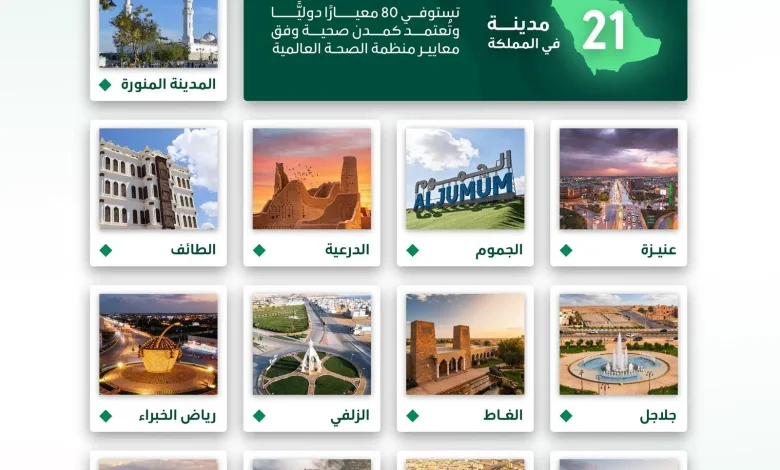
The Kingdom of Saudi Arabia continues to consolidate its regional leadership. It now leads among Eastern Mediterranean and North African countries in the number of Healthy Cities. These cities are officially approved by the World Health Organization (WHO). Consequently, the total number has impressively risen to 21 cities.
Furthermore, this qualitative achievement confirms the Kingdom’s pioneering role. It actively builds sustainable cities that place human health and quality of life at the core of urban development.
Ultimately, this success is a direct result of Saudi Vision 2030 objectives. These ambitious goals aim to build a vibrant society where all members enjoy a sustainable, healthy life.
Collaboration and International Standards
This rapid progress is the clear outcome of dedicated efforts by the Ministry of Health. Moreover, it highlights the crucial role of the General Ministerial Committee for Health in All Policies. Additionally, there has been broad, seamless integration among various government entities.
As a result, this strong collaboration contributed to unifying national efforts. It successfully transformed Healthy Cities standards into practical institutional and developmental practices.
Furthermore, the approved cities met 80 strict international standards. These standards are carefully distributed across nine main axes. For instance, they include community empowerment, cross-sectoral cooperation, and community information centers. Moreover, they cover skills development, health services, the urban environment, emergency preparedness, education, and support for small projects.

Building Supportive Urban Environments
The number of WHO-approved Healthy Cities in the Kingdom has now reached 21. The most recent additions include Abha, Muhayil Asir, and Turayb. Additionally, King Khalid University City was proudly added to this prestigious list.
Consequently, this rise reflects incredible qualitative progress in building supportive urban environments. These modern areas strongly promote both physical and mental health prevention. They achieve this through community empowerment and enhanced cross-sectoral partnerships.
Moreover, these cities focus heavily on the development of health services and improved emergency preparedness. Therefore, these combined efforts create a much better overall urban environment. Ultimately, they firmly cement the Kingdom’s position as an advanced international model in this vital field.

A Global Model for Health Integration
The Ministry of Health’s “Healthy Cities” program is highly recognized worldwide. In fact, it is the first WHO Collaborating Centre in the region. Furthermore, it is only the fourth of its kind globally.
Additionally, the program works in close cooperation with multiple government entities. Its primary goal is to transform health from a mere service delivered within medical facilities. Instead, it champions an integrated approach that extends far beyond hospitals.
This approach reaches into urban planning, education, and the environment. Consequently, it positively impacts various aspects of daily life. Ultimately, this significantly raises the overall quality of life and actively promotes much healthier, sustainable environments for everyone.
Related Topics:
MWL Gathers Muslims, Non-Muslims in US Congress Iftar
Prophet’s Biography Museum Offers Exceptional Contents
Ramadan 2025: Northern Borders Bring Bonfire Tradition to Life