World Petroleum Congress Highlights Pathways to Economic Transformation, Fiscal Sustainability

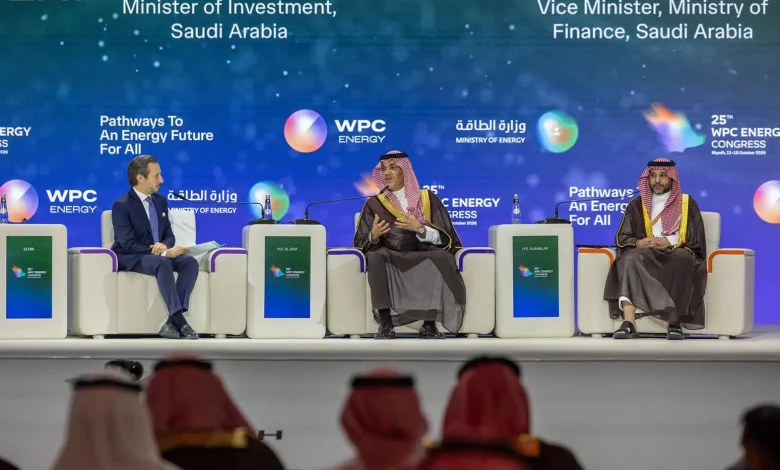
A panel session titled “Saudi Vision 2030: Economic Transformation and Global Competitiveness,” held as part of the 25th World Petroleum Congress in Riyadh, reviewed the key pillars of the Vision’s success, the management of wide-ranging economic transformation, the attraction of foreign investment, and the delicate balance required to maintain fiscal sustainability.
His Excellency the Minister of Investment, Mr. Faisal bin Abduljalil Al-Fahad, affirmed that Saudi Arabia’s investment environment has undergone a qualitative shift from a focus on “quantity” to “quality.” He noted that capital development and investment doubled over the past five years, with foreign direct investment (FDI) recording notable growth, bringing its cumulative stock to approximately SAR 1.1 trillion.
He explained that the private sector contributed more than 75% of investments during the same period, supported by the development of supply chains and economic and industrial clusters, such as automotive and maritime industries, thereby strengthening the Kingdom’s global competitiveness.
For his part, His Excellency the Deputy Minister of Finance, Mr. Abdulmohsen bin Saad Al-Khalaf, said that the Saudi economy is undergoing transformation from a position of strength and structural stability. He noted that non-oil activities now account for 55% of gross domestic product, while non-oil government revenues have grown significantly compared with their 2015 levels. This provides greater fiscal flexibility to respond to challenges and continue supporting promising sectors, including artificial intelligence, logistics, tourism, and entertainment.
In the same context, the Deputy Minister of Finance stressed that there is no contradiction between fiscal sustainability and economic growth, affirming that the two are complementary drivers. Prudent fiscal policies create the space needed to support transformation, while growth helps expand the economic base and diversify sources of income.
He also highlighted the Kingdom’s commitment to establishing strong precautionary fiscal buffers, maintaining robust data and reserve positions at the Saudi Central Bank (SAMA), and adhering to a defined ceiling for public debt as a percentage of GDP that does not exceed 40%.

The participants concluded the session by emphasizing that Saudi Vision 2030 is not merely a milestone or an interim goal, but a launching pad for building a sustainable and internationally competitive economy—one based on clarity, executive stability, and higher productivity in both the public and private sectors to secure long-term economic prosperity.
Related Topics:
New Initiative Opens Motorsports Career Pathways for Saudi Youth
Esports Nations Cup to Debut in Saudi Arabia This November
Saudi Arabia to Host Social Entrepreneurship Week Starting June 14
Spring Showers Highlight Scenic Charm of Al-Baha’s Valleys, Highlands