10 Secrets Passengers Don’t Know: Air Traffic Controllers at King Abdulaziz Airport—What Do They Do?!

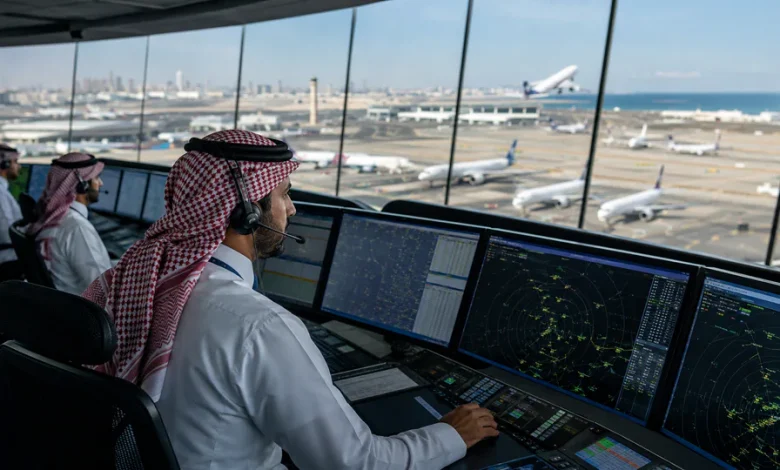
While passengers sit inside the aircraft awaiting takeoff clearance or watch from their windows as planes line up on the runways, a highly precise operation unfolds behind the scenes—one invisible to travelers—led by air traffic controllers who monitor aircraft movements moment by moment and make continuous decisions to ensure safe separation between planes and to organize takeoffs, landings and ground movements at the airport.
At King Abdulaziz International Airport in Jeddah, one of the region’s largest and busiest airports, the controllers’ task becomes even more complex amid massive operational activity that exceeded around 310,000 flights in 2025, carrying 53.4 million passengers—the highest figure ever recorded for a Saudi airport.

Controllers at King Abdulaziz Airport operate within Saudi Arabia’s national air navigation services system, which includes more than 970 air traffic controllers across the Kingdom, managing and monitoring air traffic through control towers, approach control units and regional centers.
What Does Air Traffic Controller Do?
Some travelers may assume an air traffic controller’s role is limited to clearing aircraft for takeoff or landing, but their work begins well before that and spans multiple phases of the flight.
10 Tasks Passengers Don’t See
Controllers track aircraft positions, headings, altitudes and speeds, ensuring safe separation distances between them, directing pilots to appropriate altitudes or headings, and sequencing arriving aircraft to allow safe approach and landing.
On the ground, they coordinate aircraft movements between gates, taxiways and runways so that no two aircraft move in ways that could create path conflicts.
During takeoff, pilots receive instructions on runway use, climb paths and assigned altitudes, before communication gradually transfers between different control units as the aircraft progresses on its journey.
989 Flights in Single Day
A single figure reveals the scale of pressure that operational teams at Jeddah Airport can face.
On April 3, 2025, King Abdulaziz Airport recorded its busiest day in history, handling 989 flights within 24 hours, according to an official report by Jeddah Airports Company carried by the Saudi Press Agency.
The number of flights in the first half of 2025 also exceeded around 156,000, coinciding with the reception of more than 25.6 million passengers.
The figure of 989 flights means that, on average across the day, takeoff and landing movements equated to more than 41 aircraft movements per hour, with density naturally varying from hour to hour.

3 Controllers for Runways at Once
Among the most notable developments at King Abdulaziz Airport in 2026 was the commissioning of a new airport control position named TWR-C, or the Middle Tower.
An official document issued by Saudi Air Navigation Services and the General Authority of Civil Aviation showed that, starting April 15, 2026, King Abdulaziz Airport began trialing simultaneous operations from three airport control positions, with each position responsible for one of the three runways.
Responsibilities were distributed as follows:
- Tower West monitoring Runway 16R/34L.
- Tower Center monitoring Runway 16C/34C.
- Tower East monitoring Runway 16L/34R.
Aircraft Collisions?
Air traffic controllers rely on surveillance systems, radars and digital data that display aircraft positions, direction of movement, altitude and flight information.
Using this information, they can anticipate potential convergence of two aircraft paths before it occurs, then issue instructions to one of them to change altitude, heading or speed.
Instructions may sound simple to passengers hearing them via the cockpit, but they are part of a strict international system designed to maintain separation between aircraft.

Saudi Arabia also began operating a digital Departure Clearance (DCL) service at King Abdulaziz Airport and several other major airports on May 12, 2026, enabling certain departure clearances to be exchanged electronically between the aircraft and air traffic control via data link, rather than relying entirely on voice communication.
In the first quarter of 2025 alone, King Abdulaziz Airport received 14.5 million passengers, while the number of travelers during the peak Umrah period in Ramadan exceeded 5.3 million passengers across around 31,500 flights.
More Than 850 Flights Daily
Dividing the total of 310,000 flights handled by the airport during 2025 by the days of the year shows that the average exceeded 849 flights per day.
At the same time, the average daily passenger movement at Jeddah Airport during 2025 reached around 146,000 passengers, with the airport accounting for approximately 38% of total passenger traffic across Saudi airports.
These figures make the control tower and air navigation centers among the most critical places a passenger never sees on their journey.
Related Topics:
Good News For Kids.. First Play-Doh centers in KSA Soon
Saudi Arabia Launches New Low-Cost Airline from Dammam
Saudia Launches Dammam-London Direct Flights
By 2030, 67% of Saudi Arabia’s Hotels to Achieve “Five-Star” Status