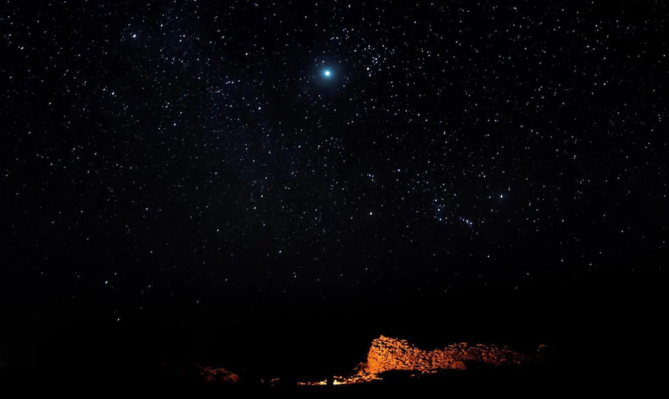
Saudi Arabia’s Northern Borders has become an iconic haven for astronomical observation with its clear desert skies and lower levels of light pollution, according to the Saudi Press Agency.
A recent report from the Visible Infrared Imaging Radiometer Suite (VIIRS) indicated that the minimal light pollution is found in the open areas surrounding Turaif, east of Rafha, and west of the city of Arar.
The VIIRS instrument represents a whiskbroom scanner radiometer, capturing imagery and radiometric data across land, atmosphere, cryosphere, and oceans in both visible and infrared wavelengths of the electromagnetic spectrum.
“The vast desert horizon and the scarcity of tall buildings contribute to improved astronomical observation conditions by minimizing ambient light and enhancing viewing quality,” SPA reported.
The region’s clear night sky allows enthusiasts to observe celestial wonders such as meteor showers and planetary conjunctions.
For these reasons, the Northern Borders has emerged as a haven for amateur astrophotographers and seasoned astrophysicists alike, providing a vast sky where celestial objects can be observed with remarkable clarity.
The Northern Borders witnessed a striking astronomical and optical spectacle as radiant light pillars rose into the night sky, attracting locals and drawing enthusiasts of natural phenomena.
A light pillar is an atmospheric optical phenomenon, appearing as a vertical column of light that stretches above or below its source. This phenomenon occurs when tiny ice crystals suspended in clouds or the air reflect the light.
Related Topics:
Northern Borders Organizes Suhail Nights 2025 Events
Strawberry Moon: Rare Celestial Event Illuminates Northern Borders