

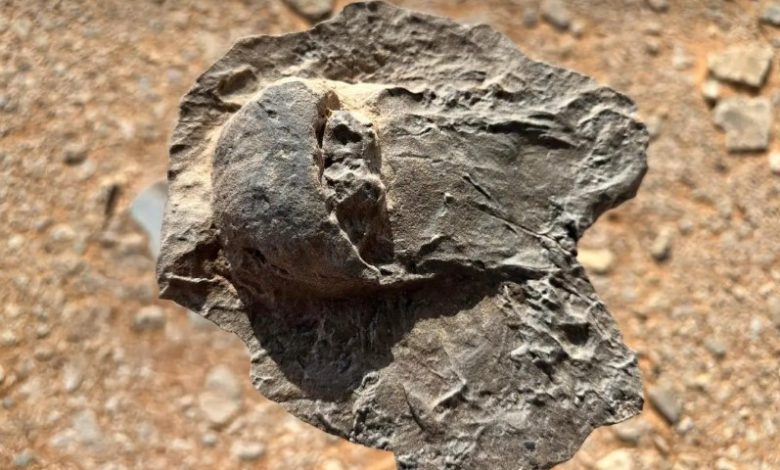
For the first time worldwide, the Royal Commission for AlUla (RCU) announced the discovery of rare horseshoe crab fossils estimated to be 465 million years old, reported the Saudi Press Agency (SPA).
This significant scientific discovery, formally documented and published in Gondwana Research international scientific journal, cements AlUla’s position as a global center for geological and scientific research into Earth’s history and biodiversity, adding an important scientific dimension to understanding the region’s natural history.
Found in the Al-Gharameel Nature Reserve, these Middle Ordovician fossils are approximately 465 million years old, placing them among the most ancient horseshoe crab fossils ever recorded.
The fossils stand out for their exceptionally large size compared to other species from the same era. Remarkably, they were found in an upside-down position – a preservation pattern never before documented – alongside trace fossils that capture the creatures’ final attempts to return to their natural position.
As part of the efforts to further strengthen #AlUla’s position as a leading global destination for geological research, @RCU_SA has announced the discovery of rare horseshoe crab fossils estimated to be approximately 465 million years old. The discovery has been formally… pic.twitter.com/aoMpWl2yhM
— الهيئة الملكية لمحافظة العلا (@RCU_SA) January 8, 2026
Analysis of the geological strata reveals a pattern of recurring, high-intensity seasonal storms. This suggests that the horseshoe crabs congregated in shallow nearshore environments where such storm events triggered rapid burial, facilitating their exceptional preservation within the sedimentary layers.
The results also establish AlUla as a former coastal environment, introducing a vital scientific dimension to the reconstruction of its natural history. Furthermore, this milestone reinforces AlUla’s growing reputation as a global hub for world-class scientific research and natural history discovery.
A joint effort between the RCU and Flinders University will see this new fossil species officially classified in the first half of 2026. This partnership establishes AlUla as a global destination for scientific research, supporting Saudi Vision 2030’s goals to foster innovation and expand the Kingdom’s cultural and intellectual footprint.


